These days, MMO – or Massive Multiplayer Online – games are ubiquitous. Twelve million people play World of Warcraft, and over 70 million play Farmville. None of this would be possible without computers and the internet, which is why games of such scale and a relatively newcomer in human history.
However, massive gaming didn’t start in 1985 (with usenet), or 1995 (with the intertubes)… it was already existent in the form of PBM’s, or Play-By-Mail games.
Play-by-mail is a type of game system where the players submit ‘orders’ to a referee who processes them and sends ‘reports’ back to each use to update them on the state of the game. Because every players turn is processed automatically, strategy plays a large element: what will you do, and in which order will you do it. Rarely do you control a single unit in a game, so you must issue orders for every character/army/spaceship you control. PBM games of virtually any genre have been run since the 1960s, but they are most often strategy wargames as this style of game lends itself to a strictly regimented, turn-based system. The number of players in a single game varies, but can be up to hundreds. Some games have fixed length (X total turns), others run indefinitely. Earlier I was reading about a fantasy wargame that ran for 5.5 years and had about 470 total players!
Here is a fantastic account of a few turns in the PBM game Lizards!
As a child I used to read the ads in the back of Dragon magazine, or the various UK gaming mags, and my imagination would run wild. The games sounded so fanciful and exotic that I could only dream of playing. The costs however were prohibitive, so I never did.
Looking through those very same Dragon magazines today the cost seems even higher than they did 25 years ago. Even today I would baulk at $2 or even $5 per turn (weekly or monthly), but imagine how high that was back then? And $20 for a rulebook? This was in the days the entire D&D box set cost $12!
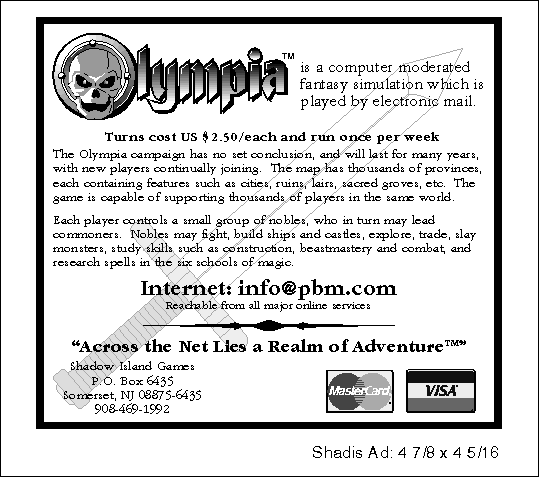
Over the years the onset of the internet dealt PBM gaming a blow, but not a killing blow. Games still are still being played and being ran, but now orders are most often issued via email or custom software. True PB-snail-mail games are still run though, although these days are rare.
I have never played a true PBM game, and likely never will. However my awareness – and fascination – has never diminished. Several years ago I did preliminary design for a PB-email game that I wanted to write with my brother, and when he finally gets his act together and obtains a iOS dev kit, the first game we create will also be a PB-email variant.
So who knows, maybe one-day I’ll finally get to play-by-email myself 🙂